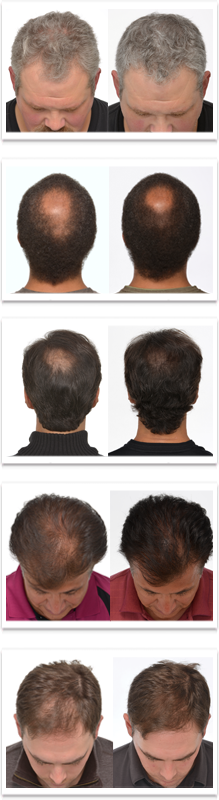
The Growth of Human Scalp Hair Mediated by Visible Red Light Laser and LED Sources in Males
Low-Level Laser Therapy (LLLT) has been studied and used to promote hair growth. A double-blind RCT was undertaken to define the safety and physiologic effects of LLLT on males with Androgenetic Alopecia.
A double-blind RCT was undertaken to define the safety and physiologic effects of LLLT on males with androgenic alopecia.
The study aimed to define the safety and physiologic effects that occur when the human hair follicle and surrounding tissue structures are exposed to LLLT using a novel bicycle helmet type device that is fitted with an array of laser and LED light sources operating at 655nm. The trial was conducted as per the IRB approved TH655 protocol (Essex IRB, Lebanon, NJ). The laser system is classified by the FDA as a class 3R laser.
The LED components are non-classified light sources when marketed for cosmetic applications, as is the case in this application.
44 males (Ages 18-48, Fitzpatrick I-IV, Hamilton-Norwood IIa-V) were recruited. A transition zone scalp site was selected; hairs were trimmed to 3mm height; the area was tattooed and photographed. The laser group received a “TOPHAT655” unit containing 21, 5mW lasers and 30 LEDS, in a bicycle-helmet like apparatus. The placebo group unit appeared identical, containing incandescent red lights. Patients treated at home for QOD x 16 weeks (60 treatments, 655±5nm, 67.3J/cm2 irradiance/ 25 minute treatment), with follow up and photography at 16 weeks. A masked 2.85cm2 photographic area was evaluated by another blinded investigator. The primary endpoint was the percent increase in hair counts from baseline.
41 patients completed the study. (22 laser, 19 placebo). No adverse events or side effects were reported. Baseline hair counts were 162.7 ± 95.9 (N=22) in placebo and 142.0 ±73.0 (N= 22) and laser groups respectively (P= 0.426). Post Treatment hair counts were 162.4 ± 62.5 (N= 19) and 228.7 ± 102.8 (N= 22) respectively (P=0.0161). A 39% percent hair increase was demonstrated (28.4 ± 46.2 placebo, N=19; 67.2 ± 33.4, laser, N=22) (P=0.001) Deleting one control group subject with a very high baseline count and a very large decrease, resulted in baseline hair counts of 151.1 ±81.0 (N=21) and 142.0 ±73.0 (N=22) respectively (P=0.680). Post treatment hair counts were 158.2 ± 61.5 (N= 18) and 228.7 ±102.8 (N= 22) (P=0.011), resulting in a 35% percent increase in hair growth (32.3 ±44.2, placebo, N=18; 67.2 ±33.4, laser, N=22) (P=0.003).
LLT of the scalp with the TOPHAT655 device significantly improved hair counts in males with androgenetic alopecia.
Download the Clinical Trial Abstract
 Cart (